All this year I (Beth Cougler Blom) have been working on a special project: writing and publishing my next book, which will be called Everyday Acts of Facilitation: Learning to Facilitate Through Life’s Ordinary Moments.
I’ve been documenting some of my writing journey along the way in sporadic posts over on my personal LinkedIn profile. If you missed them, this post republishes them here. I talk about my big questions, writing retreats, moments of self-doubt, and wins along the way.
Although I started researching and pulling notes together for the book in early fall 2024, it was only in May 2025 that I started to talk about what I was doing publicly and these posts start at that time.
Learn more about the book, and sign up to be notified when it’s available, over on this webpage.
May 6, 2025
I’ve been working on a very cool project behind the scenes and think it’s about time I shared what I’m doing more widely. I’m writing my second book, and it’s going to be called Everyday Acts of Facilitation.
It’s a book primarily for “accidental facilitators”, those of you who are at a turning point in your career, just realizing that what you’ve been doing (leading workshops or meetings) is called facilitation—and that facilitation is a thing! You’re wondering how to gain more skills to do this work well.
Yes, you can and should take formal facilitation courses to build your skills. But in Everyday Acts of Facilitation, I’ll show you how you can learn facilitation by paying closer attention to the small moments you experience daily, just going about your life.
I have a feeling that more than just new facilitators are going to benefit from this book. (Let me know if you think so, too!) I can’t wait to share more as I continue to write the book.
May 13, 2025
I’m currently working on writing the draft introduction and a sample chapter for Everyday Acts of Facilitation, my next book. My goal is to send both short documents to my book coach for her review ahead of the meeting we have scheduled next week.
Once I get feedback from Adrienne on these early drafts, I’ll be able to apply what I’ve learned to write the rest of the chapters. I’ve got a writing retreat planned in less than two weeks where I’ll be able to immerse myself in the writing process and move the manuscript draft forward by leaps and bounds—I hope!
When I was writing my first book, Design to Engage, I went away on two writing retreats at nearby Vancouver Island hotels. I usually took a bunch of groceries with me as well as my laptop, some inspiration books, and supplies like Sharpies and sticky notes so I could put ideas on the walls. These self-scheduled retreats are intense weekends which include a lot of me writing and reading my work aloud interspersed by eating yummy snacks (hello chocolate) and going for walks to crystallize my thoughts. I LOVE these weekends and can’t wait to head out on this one!
Everyday Acts of Facilitation will have a different feel than Design to Engage because it will feature many short chapters instead of a few longer ones. Each chapter will explore a different facilitation skill that I think we can see happening around us in everyday life. I can’t wait to share some of these ideas and stories with you!
May 20, 2025
This past weekend was a long one here in Canada, and I found myself drifting back to my computer now and then to tackle small writing tasks.
I did some relaxing too (!) but book-wise, one of the things I did was scroll back through my posts on both my business and personal Instagram accounts, looking for evidence of everyday acts of facilitation.
There were many!
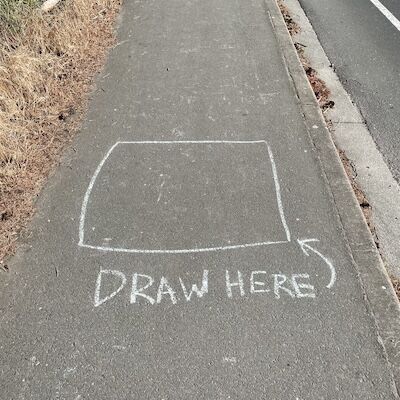
Here’s a tiny everyday act of facilitation I thought I’d share here (it may not make it into the book). Would you have added something to this “Draw Here” sidewalk chalk invitation if you’d come across it? What would you have drawn?
Oh, and while I’m thinking about it…if you ever want to write a book in your field one day, start collecting things now that could help you write it later. Gather insights in your Instagram feed, a Scrivener file, a paper journal, or even in the Notes app on your iPhone.
May 27, 2025
This past weekend I went on a (self organized) solo writing retreat to work on the book. I drove to a hotel about an hour and a half away (in Oyster Bay, for all you Island folks who might be reading) and just hunkered down for the weekend in my room with snacks, my travel yoga mat, and of course my laptop.
It was a productive time and an enjoyable one. Because I’ve recently been diagnosed with mal de debarquement syndrome after getting off a cruise ship over three months ago, I’ve been finding it’s not great to sit at the computer for long periods of time. If you haven’t heard of this, it basically means I feel like I’m still on a cruise ship even though I’ve been on solid land since early February. Still, I persist. I’m loving this project!
I did have to take a lot of breaks and the yoga helped to stretch me out from time to time. I do forget about my imbalance issues when I get deep into a thinking/writing project like this one, thank goodness. (And yes, I’ve gone to specialists and am doing exercises to try to get my balance back. It’s a work in progress.)
I wrote about 10,000 words this weekend, maybe a little more. This felt good. I’m very much in the first draft stage of writing. There are parts of chapters that I’m really happy with, I’m loving some of the turns of phrase I’ve been able to use. I made myself cry at one point rereading my work out loud so I think I’ve put my heart into this book somewhat so far! Do you think that’s a good sign? Facilitation is heart-based work, after all, right?
I have a lot more to do but wanted to share this little update. I heartily recommend the solo-booked retreat and can share tips about how to do it well if any of you are thinking about doing one for a project you’d like to carve out time for. It’s so good!
June 6, 2025
I’ve only made a few progressions on the book since going on my solo writing retreat recently, but I’m happy when I can get anything done on it outside of my regular work—so I’ll take it. I was planning for and facilitating an important virtual workshop for a client this past week, among other projects, but have gotten some good work done on the book today, so that feels good.
I’ve now received feedback from both my book coach and my colleague Carla on the draft introduction and sample chapter I had sent them to review, so I now know the structural pattern I’ve established for each chapter is going to work. I think we’re all happy with the tone and language I’m using as well.
I’m also thinking about future publication. When I wrote Design to Engage, I had a clear vision of what the book should look like in many respects, including what is called the trim size, the physical size of a book. Design to Engage is 8×10 inches but I’m thinking Everyday Acts of Facilitation needs to be a smaller book of about 5.5×8.25 inches. Do you have any advice for me to consider around the future size of the book?
A friend (she knows who she is) gave me some good advice this week on the topic. Do you agree that if I’m pitching this book to “accidental facilitators”—people just discovering that facilitation is a thing—that a smaller, more portable book might be an easier entry point than something which looks a little more like a textbook, like Design to Engage does? (Even though I tried pretty hard to make it look gorgeous and easy to read!) I’d love to know your thoughts. What do you hope for in a physical book?
June 19, 2025
When I wrote my first book, I got up in the morning about 5:00 or 5:30am and wrote until 7:00am. I did this at least five days a week for many months. I can’t seem to do this now for this book project, though. I think I still remember how intense that was, doing it on top of my regular workday. It’s different now.
What I’m doing these days on this book project is carving out writing time during either my early morning, regular workday, or weekend hours—whenever I can fit it in. I’m working on it each week, but I’m not overworking on it. Do you know what I mean? It feels good, and it feels doable.
I’m working my way through all the draft chapters I’ve outlined, pulling thoughts and stories together into (hopefully) coherent wholes. It’s such a reflective journey, thinking back to particularly the informal moments in my life where I made a choice to do something that has helped me become a better facilitator. An example? When I was in university, I joined the foot patrol, to help students get home safely at night. Why did I choose to volunteer in that way? I have no idea. But now I know it helped me talk to strangers, make people feel comfortable, and yes, even learn a little bit of (now old school) technology as we worked with walkie talkie equipment!
I’m starting to joke that it turns out that I’ve spent my whole life learning how to be a facilitator! I didn’t see it then, but I see it now. For those of you who have been doing this work for a while, I bet you would find those moments in your trajectory as well. Can you think of any?
July 2, 2025
This weekend I sent off the draft introduction to the book, along with three draft chapters, to a friend who gave me stellar feedback when I was writing my first book. I’m hoping she gives me magical notes again this time—no pressure, right?—which will help uncover some things I can’t see as I gaze at the world of facilitation down my own nose.
It makes me think to ask you about the stories you might have told yourself as you were learning facilitation, or maybe that you’re telling yourself right now. Especially if you’re newer to facilitating either meetings or workshops, I’m curious if you’re worried or wondering about anything related to being able to do it. What makes you doubt that you can do this work? What certainties do you have about how good you are, or you’ll be, at it? I’d love it if you commented here or dropped me a DM to share. The more I know about particularly what might be stopping you or making you doubt yourself about doing this work, the more I can speak to it in the book. That’s part of the plan anyway!
Everyday Acts of Facilitation is my upcoming book to help people notice and strengthen the skills they’re already using in everyday life that can help them become better facilitators.
July 11, 2025
This past week I had the meeting I was telling you about was going to happen, with my friend who gave me stellar feedback when I was writing Design to Engage. After reading the draft Introduction and a few draft chapters of Everyday Acts of Facilitation, she gave me fantastic advice about how I should make tweaks to what I’m doing so far so that the book is more useful for you. As the British would say, she was brilliant!
I continue to spend time mining all sorts of “stuff” I’ve done or written related to facilitation that fits the intent and purpose of this book. Believe me, after more than 20 years in the world of facilitation, there is a lot to go through! I started watching old recordings of virtual sessions I’ve led and, as much as I’m not a fan of recording sessions in general (because I think it can change the conversation in the virtual room), those times where I’ve had to do it are now pretty useful to me—I can go back and watch myself and others in action. Because I’ve taught facilitation and learning design for years, and invited many meta-level conversations to help participants look back at the activity they were just in and then think about what happened in that activity from a facilitator viewpoint, it gives me lots to look back on now and potentially use in the book. (Which makes me want to reiterate…if you ever want to write a book yourself in the future, always capture as much as you can about your work and your thinking about it. You will thank yourself later!)
I’m looking forward to heading off on another solo writing retreat soon to sit with my thoughts and my writing and make progress on the book. I know I’m going to need a lot of breaks because I’m still dealing with the disembarkation syndrome that I’ve had since February. But I persist. It’s a good thing I love writing and thinking about facilitation!
July 27, 2025
Well, I’m on the other side of my writing retreat that was supposed to happen in Hope, BC, but ended up happening in Mission, BC! When I got to the Hope place, the place reeked of cigarette smoke, so I ended up getting a full refund and scrambling to find another place in the Lower Mainland which wouldn’t break the bank—no small feat in that area in the summertime!
I found a non-descript room in a Best Western hotel and holed up there for three nights. I let myself out a couple of times, to walk beautiful Heritage Park in Mission, have some Thai food, and visit a local bookstore. (If anyone is interested, it’s a cute store called Totally Bookish on London St.)
I got a lot of work done on the book, but not as far as I thought I would. I finished 14 chapter drafts, and maybe about 10 more about 75% of the way there, but I think I’ll have about 30-34 short chapters in the end, so it feels like I still have a long way to go. (And this is just getting to the first draft!) But I’m in a mode of “it takes as long as it takes”, perhaps inspired by the good book I just read—Leddy and Miller’s Teaching Where You Are: Weaving Indigenous and Slow Principles and Pedagogies.
I do think I could use some volunteer beta readers at this point to read the draft introduction and the 14 drafted chapters to see if I’m on the right track. If you identify as an “accidental facilitator” who is fairly recent at learning that facilitation (of meetings or workshops) is a “thing” and you’re wondering how you could learn more about the field, and you’d be interested in beta reading part of this book for me, could you reach out? I’d appreciate your insights right now and thank you in advance! To be clear, it’s better if you’re not an expert facilitator who has been working in the field for years for this task. Thank you!
P.S. If anyone is curious, I did find that three nights was too much for a solo writing retreat. Usually I do two nights away and I think that’s a good sweet spot for future retreats. I think I experienced the law of diminishing returns at some point, probably because my brain was getting tired!
August 5, 2025
I just got back from Quebec City, where I visited with my parents (who had travelled there as well) and picked up my daughter from a school she had been attending for the past five weeks. (Quick shout out to Canada’s Explore program which provides amazing language immersion opportunities for students every summer!)
I took my laptop with me and was able to get some book writing done on the plane and during some downtime at the hotel—when we weren’t taking in the sights of beautiful Quebec City of course! (Aside: If you’re planning a trip to Canada or within Canada anytime soon, Quebec City and Montreal would be two good stops on your itinerary. They are a long way away from where I currently live in Victoria, British Columbia, and a completely different cultural experience as well.)
Anyway, back to the book-writing progress. Thanks to those of you who reached out to be beta readers for my first draft chapters after I put out a call in my last book update. Because I wrote a number of those chapters while under the brain fog caused by the imbalance syndrome I’ve had since February, I’m relying somewhat on Carla (on my team), along with these beta readers, to let me know if I’ve been making sense.
That said, I’m happy to report that the brain fog has lifted. I now feel like I’m back in my body and not floating above it as I go through life. I must be healing from this mal de debarquement syndrome—though slowly—because now I feel like my confidence is returning. And I’m starting to believe that people may just enjoy and find benefit from this upcoming book after all. It’s definitely been a journey to navigate. I share this because experiencing health issues is not only a thing to deal with in itself, the cognitive effects can be very real. I’m taking care of myself but I’m also making time to work on this passion project.
I’ve now finished 23 draft chapters and have about 10 more to go. All I can say is I’m super excited to get feedback from the beta readers, finish the manuscript, and send it off for the various types of editing. (This means several more drafts are in my future!) Since I’ve been taking editing courses at SFU over the past year or so, I’ll be approaching this next phase with fresh eyes, too.
August 26, 2025
I’m days away from submitting my book draft to the editor. It’s been a whirlwind month, working every weekend on the manuscript and fine-tuning many details. I’ve received positive feedback from beta readers, which has given me a lift. I think the manuscript is in good shape, but we’ll see what the editor says.
The editor’s role is to read the draft and share some recommendations on the way forward. Does my premise, that we can learn facilitation skills in life’s ordinary moments, hold up? Do my stories, of both life and facilitation, make sense, engage, and inspire? Have I been clear and concise?
It’s no small thing. Write 63,000 (ish) words and just make it all make sense! But I love it, and it’s even more exciting now that the finish line seems to be coming into sight. Thanks for all of you who have encouraged me so far!
October 5, 2025
So much has happened in the last month with regards to the book!
I pressed Submit on the draft manuscript at the end of August and since then it’s been to a structural editor for a manuscript evaluation. Happily, their feedback was very positive, saying things like, “I expect audience reception for this book to be very positive,” and “The first thing I love about this manuscript is how approachable and engaging it is.” YES! This was great news, and I’m currently making minor changes to the manuscript and sending it in portions over to Carla on my team for copy editing.
At the same time, we’re working on the book cover design which is such a crucial part of the overall project. When I wrote Design to Engage it took a couple of tries to get to current cover design which I still really love. I know we’ll get there with this book too—it just takes a few minds working together to do it!
October 30, 2025
Will you help me perfect my back cover copy and bio for my upcoming book?
The book’s title will be Everyday Acts of Facilitation. What delights or confuses you in the copy below? Please share!
—
If you view the world around you as your training room, then anyone you meet can help you learn something about facilitation.
Part guidebook and part memoir, Everyday Acts of Facilitation invites you to notice how the mindsets, skills, and strategies of facilitation show up in everyday life—and why they matter when you’re leading meetings, learning events, or collaborative work of any kind.
Whether you’ve just discovered that facilitation is a thing, you’re keen to enhance the facilitation work you’ve been doing alongside your main job, or you’ve been a professional facilitator for years, you’ll find value in this thoughtful, story-filled exploration of how we can facilitate—and live—more intentionally.
Bio
Beth Cougler Blom is a facilitator and learning designer who, along with her team at BCB Learning Inc., designs and facilitates engaging, inclusive learning experiences for clients. She is the host of the Facilitating on Purpose podcast and the author of Design to Engage: How to Create and Facilitate a Great Learning Experience For Any Group. Beth lives near Victoria, British Columbia, Canada, with her husband and daughter.
November 8, 2025
I’m so happy to share with you the cover of my upcoming book, Everyday Acts of Facilitation. (Just disregard the trim marks!)
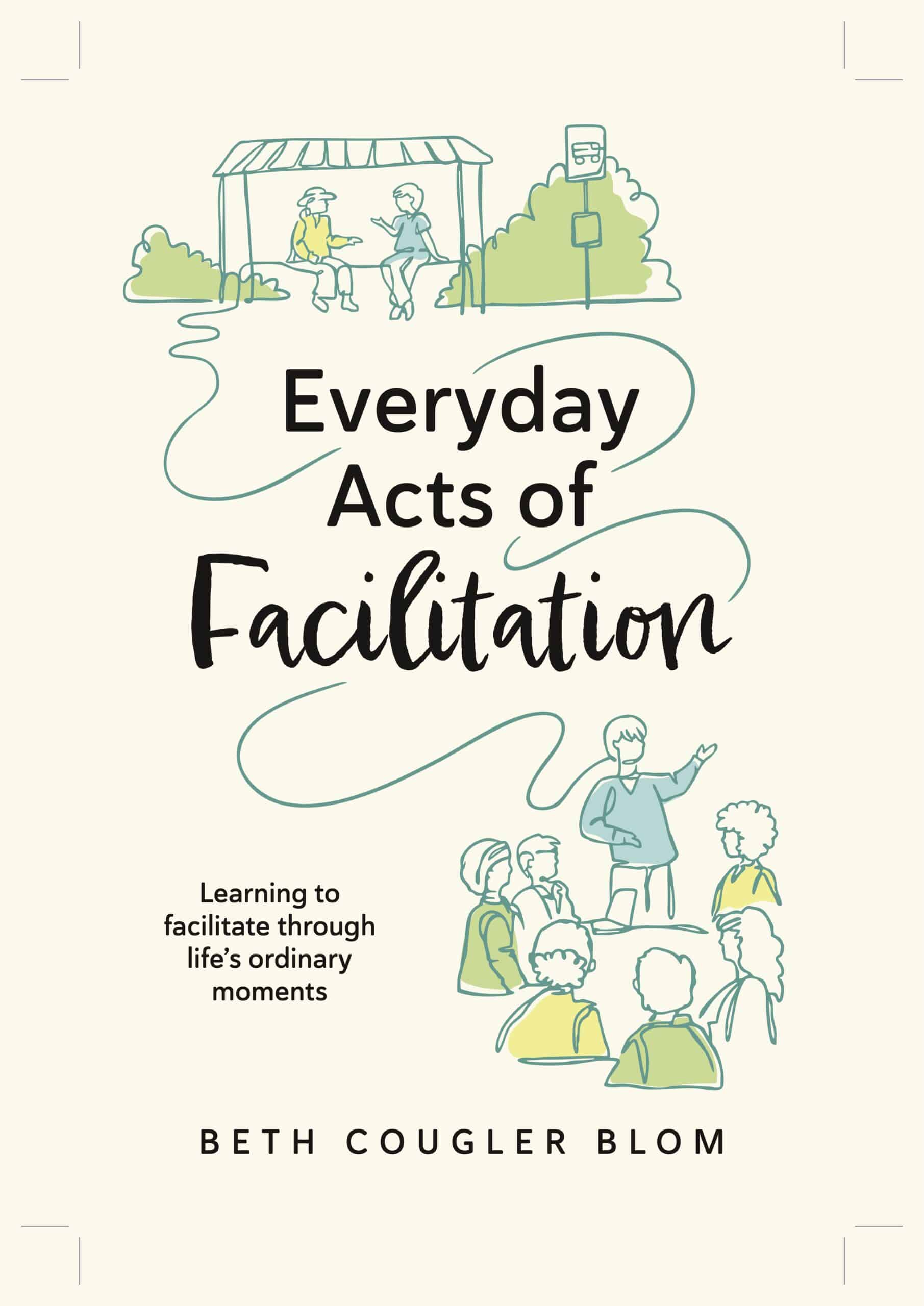
This is the fantastic work of graphic designer/illustrator Emily Johnston of Artio Design Co, who we’ve been working with for several years. Emily is extremely talented and a dream partner on creative projects of all kinds related to our work in learning design and facilitation.
The manuscript for Everyday Acts of Facilitation is just about to get locked and will head into layout within the next couple of weeks. Thanks for sharing my journey so far. I can’t wait to let you know when it’s ready for order!
November 22, 2025
The manuscript is with the proofreader and, after what will likely be an easy revision process, layout will be the next step. It is starting to feel real that Everyday Acts of Facilitation will be available early in the new year…I’m getting there!
Thanks to all of you who have been so supportive and excited about this endeavour and about getting my new book in your hot little hands. It spurs me on and makes me even more excited to plan for its release in 2026.
If you haven’t heard yet, I’ve written a new book about facilitation, following the success of my first book, Design to Engage. This one, Everyday Acts of Facilitation, invites you to notice how the mindsets, skills, and strategies of facilitation show up in everyday life—and why they matter when you’re leading meetings, learning events, or collaborative work of any kind.
December 13, 2025
My book manuscript is back from the proofreader and I’ve made final revisions and submitted it! I could leave no stone unturned with this one: I had to print out the book, read it all again and make sure everything is perfect.
Next step: layout.
Can’t wait to share Everyday Acts of Facilitation with you in the new year!